Safety

WINLEVI IS GENERALLY WELL TOLERATED2,13,14,17
PRECAUTIONS2

  • WINLEVI® is for cutaneous use only.
  • The affected areas should be clean and dry before application.
  • WINLEVI® should not be applied to cuts, abrasions, eczematous or sunburned skin.
  • The cream must be applied without using occlusive dressing to avoid an increased risk for systemic undesirable effects (see section 4.4 of the Summary of Product Characteristics).
  • Other cutaneous medicinal products used to treat other conditions on the same skin areas should be applied with a minimum of two hours before or after the application of WINLEVI®. This is also applicable to the use of sunscreen or emollients.
  • The patient should bei instructed to apply a thin, uniform layer of WINLEVI® to the affected area, massaging gently, avoiding the eyes, eyelids, lips and nostrils, and then wash hands after application (see section 4.2)
  • The cream must be applied to the entire affected area and not to the acne lesion only.
  • Contraindications:
    -    Hypersensitivity to the active substance or to any of the excipients
    -    Pregnancy

No interaction clinical studies, including interaction studies with other topical treatments, have been performed. Caution should be exercised in using WINLEVI® with other drugs known to suppress the HPA axis.

Please read the safety section and special warnings and precautions for use before prescribing.

SPECIAL WARNINGS AND PRECAUTIONS2

Hypothalamic-pituitary-adrenal (HPA) Axis Suppression

  • In a dedicated phase 2 clinical study, adults and adolescents from 12 to < 18 years of age showed stimulated levels of ACTH (adrenocorticotropic hormone), indicating HPS-axis suppression. No clinical signs or symptoms of adrenal suppression were observed. Upon discontinuation of treatment the laboratory test results normalised within 4 weeks.
  • Typical symptoms of HPA-axis suppression include fatigue, weight loss, decreased appetite, low blood pressure, hypoglycemia, nausea, diarrhoea, vomiting, or abdominal pain. Patients should be instructed to inform their physician if they develop any symptoms of HPA-axis suppression. If adrenal insufficiency is suspected, morning serum cortisol levels could be measured and the patient may be referred for endocrinological evaluation; treatment should be interrupted if HPA axis suppression is confirmed.
  • Laboratory-based evidence of HPA axis suppression was more frequently observed in adolescents than in adults. In order to reduce the systemic absorption, use in adolescents must be limited to the face.

Local skin reactions

  • Clascoterone may induce local irritation (such as erythema, pruritus, scaling/dryness, stinging/burning), mostly of minimal or mild severity. Caution should be used when applying to sensitive areas of the skin, such as the neck, and in case of concomitant use of cutaneous anti-acneic treatments and other products (i.e. medicated or abrasive soaps and cleansers, soaps and cosmetics that have a strong drying effect and products with high concentrations of alcohol, astringents, spices or lime). Such products should be applied with a minimum of two hours before or after the application of WINLEVI®. If a local skin reaction in a sensitive area occurs, treatment discontinuation should be considered; emollients may also be applied with a minimum of two hours before or after the application of WINLEVI®. Avoid application to abraded, eczematous skin or patients with inflammatory skin conditions that may coexist with acne, e.g. rosacea or perioral dermatitis.
  • If a local skin reaction in a sensitive area occurs, treatment discontinuation should be considered; emollients may also be applied with a minimum of two hours before or after the application of WINLEVI®. Avoid application to abraded, eczematous skin or patients with inflammatory skin conditions that may coexist with acne, e.g. rosacea or perioral dermatitis.
  • Avoid application to abraded, eczematous skin or patients with inflammatory skin conditions that may coexist with acne, e.g. rosacea or perioral dermatitis.
  • In patients, whose skin has been subjected to procedures such as depilation, chemical peels, dermabrasion or laser resurfacing, the skin should be allowed to recover before application is considered.
  • Concomitant use with photodynamic therapy is not recommended. Treatment with WINLEVI® should be discontinued prior to initiating photodynamic therapy.

Rebound effect

  • The rebound effect (i.e., an exacerbation of acne vulgaris) following treatment withdrawal was not assessed during the clinical studies. Rebound effect was reported for compounds structurally related to clascoterone (i.e., topical corticosteroids) and cannot be excluded for WINLEVI®. Should there be a reoccurrence of acne vulgaris within days to weeks after successful treatment of the condition with this medicinal product, a withdrawal reaction should be suspected. Reapplication should be done with caution and medical advice is recommended in these cases, or other treatment options should be considered.

Women of childbearing potential

  • Women of childbearing potential have to use an effective contraceptive method during treatment and for at least 10 days after the last dose. The pregnancy status should be verified before initiating treatment with this medicinal product in women of childbearing potential.

Educational materials:
Educational materials regarding these precautions are available for healthcare professionals and patients (or parents/caregivers). A patient card is provided with the package of this medicinal product.
Excipients with known effect

  • Cetyl alcohol: This medicinal product contains 25 mg cetyl alcohol in each gram. Cetyl alcohol may cause local skin reactions (e.g. contact dermatitis).
  • Propylene glycol: This medicinal product also contains 250 mg propylene glycol in each gram. Propylene glycol may cause skin irritation.

SAFETY PROFILE OPEN LABEL EXTENSION STUDY17

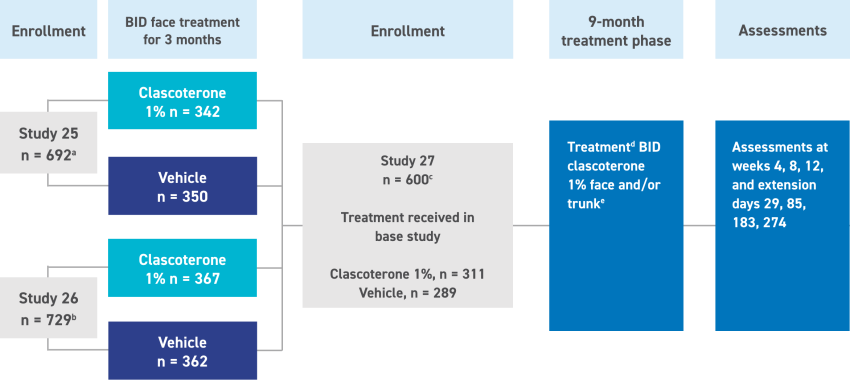
STUDY DESIGN

a Number of ITT patients ≥ 12 years of age enrolled in Study 25.
b Number of ITT patients ≥ 12 years of age enrolled in Study 26.
c Number of ITT patients ≥ 12 years of age enrolled in the long-term extension study (Study 27).
d Patients who achieved IGA score of ≤1 could stop treatment and resume if/when acne worsened.
e Total clascoterone treatment duration was up to 12 months for patients treated with clascoterone for 3 months in the pivotal studies.

BID, twice daily.

(adapted from Eichenfield et al. 202417)

Study results:18

  • Consistent with previous studies erythema/reddening was the most common local skin reaction.
  • No systemic side effects were noted.
  • There was a low frequency of TEAEs.
  • Long-term safety of clascoterone cream 1% and vehicle-treated individuals from the phase Ill trials were enrolled in an open-label, single-arm, 9-month extension study.
  • Safety results consistent with phase Ill trials.
  • Safety data included face and trunk events.

TEAE, treatment emergent adverse event.

(adapted from Eichenfield et al. 202018)

SAFETY DATA2

The most frequently occurring adverse reactions are local skin reactions such as erythema (11.5%), scaling/dryness (10.0%), pruritus (7.4%) and stinging/burning (4.0%). These reactions were usually self-limiting and resolved during use of this medicinal product.

ADVERSE REACTIONSa

Paediatric population

Among the 444 subjects aged 12 to < 18 years enrolled in phase 2 and phase 3 vehicle-controlled studies for acne vulgaris and exposed to clascoterone cream, the overall incidence of adverse reactions was 4/444 (0.9%). Frequency, type and severity of adverse reactions through week 12 were similar to those in adults as presented in table shown above, which covers both populations.

FERTILITY

There are no data on the effect of clascoterone on human fertility. Results from animal studies following subcutaneous administration showed no effect on fertility in male or female rats.

WOMEN OF CHILDBEARING POTENTIAL

Women of childbearing potential have to use an effective method of contraception during treatment and for at least 10 days after the last dose. No interaction clinical studies have been performed, therefore, an interaction with hormonal contraception cannot be excluded. The pregnancy status should be verified before initiating treatment with clascoterone in women of childbearing potential.

PREGNANCY

There are no or a limited amount of data from the use of cutaneous clascoterone in pregnant women.
Animal studies have shown reproductive toxicity following subcutaneous administration. Although systemic absorption of cutaneous clascoterone and its main metabolite cortexolone, is negligible, there could be individual factors (e.g. use over large surfaces, prolonged use) that may contribute to an increased systemic exposure. Based on animals studies and its mechanism of action (androgen receptor inhibition), clascoterone can cause fetal harm.
This medicinal product is contraindicated during pregnancy.
The patient must be informed and understand the risks related to the use of this medicinal product during pregnancy.

BREAST-FEEDING

It is unknown whether clascoterone/metabolites are excreted in human milk. A risk to the newborns/infants cannot be excluded.
Use of this medicinal product is not recommended while breast-feeding or breast-feeding should be discontinued during treatment with this medicinal product.

a Frequencies have been evaluated according to the following convention: very common (≥ 1/10), common (z 1/100 to <1/10), uncommon (2 1/10,000 to <1/1,000), very rare (<1/10,000) and not known (cannot be estimated from the available data).
b Assessed in the dedicated phase 2 study at supratherapeutic dosages.
Explore more
Indication

WINLEVI® (clascoterone) 10 mg/g cream is indicated for the topical treatment of acne vulgaris in patients 12 years of age and older.3

Adverse event reporting

Adverse events should be reported. Reporting forms and information can be found at yellowcard.mhra.gov.uk. Adverse events should also be reported to Glenmark Pharmaceuticals Europe Ltd medical_information@glenmarkpharma.com or call 0800 458 0383.

References

This medicine is subject to additional monitoring. This will allow quick identification of new safety information. You can help by reporting any side effects you may get. See yellowcard.mhra.gov.uk for how to report side effects.


  1. Kurokawa I, et al. Dermatol Ther (Heidelb). 2021;11(4):1129-1139.
  2. Tuchayi S, et al. Acne vulgaris. Nat Rev Dis Primers. 2015; 1:15029.
  3. WINLEVI® SPC
  4. Piszczatoski CR, Powell J. Clin Ther. 2021;43(10):1638-1644.
  5. Rosette C, et al. J Drugs Dermatol. 2019;18(5):412-418.
  6. Eichenfield LF, et al. J Drugs Dermatol. 2024;23(1):1278-1283.
  7. Purdy S, DeBerker D. BMJ Clin Evid. 2008;1714.
  8. Zouboulis CC, Bettoli V. Br J Dermatol. 2015;Suppl 1:27-36.
  9. ONS. Estimates of the population for the UK, England, Wales, Scotland and Northern Ireland. Accessed 27 June 2024. https://www.ons.gov.uk/peoplepopulationandcommunity/populationandmigration/populationestimates/datasets/populationestimatesforukenglandandwalesscotlandandnorthernireland.
  10. Primary Care Dermatology Society. Acne: acne vulgaris. Accessed 27 June 2024. https://www.pcds.org.uk/clinical-guidance/acne-vulgaris.
  11. Dawson AL, et al. BMJ. 2013;346:f2634.
  12. Layton AM, Thiboutot D, Tan J. Br J Dermatol. 2021;184(2):219-225.
  13. Morshed ASM, et al. Sci Rep. 2023; 13: 21084.
  14. Baldwin, H et al. J Drugs Dermatol. 2023;22(6):582-587.
  15. Del Rosso JQ, Kircik L. J Dermatolog Treat. 2024;35(1):2298878.
  16. Kim HJ, et al. Int J Mol Sci. 2024;25(10):5302.
  17. Hebert A, et al. J Drugs Dermatol. 2023;22(2):174-181.
  18. Hebert A, et al. JAMA Dermatology. 2020;156(6):621–630
  19. Abelson MB, Fink K. (2003). Controlling for the Placebo Effect. Review of Ophthalmology. Accessed 17 October 2024. https://www.reviewofophthalmology.com/article/controlling-for-the-placebo-effect.
  20. Hebert A, et al. JAMA Dermatology. 2020;156(6):621–630 (Supplement 1).
  21. Shergill M, et al. Dermatol Ther (Heidelb). 2024;14:1093–1102.
  22. Eichenfield L, et al. J Am Acad Dermatol. 2020;83(2):477-485.
  23. Mazzetti A, et al. J Drugs Dermatol. 2019;18(6):563.
  24. NICE Clinical Knowledge Summary WINLEVI®

Depicted people are not actual patients.